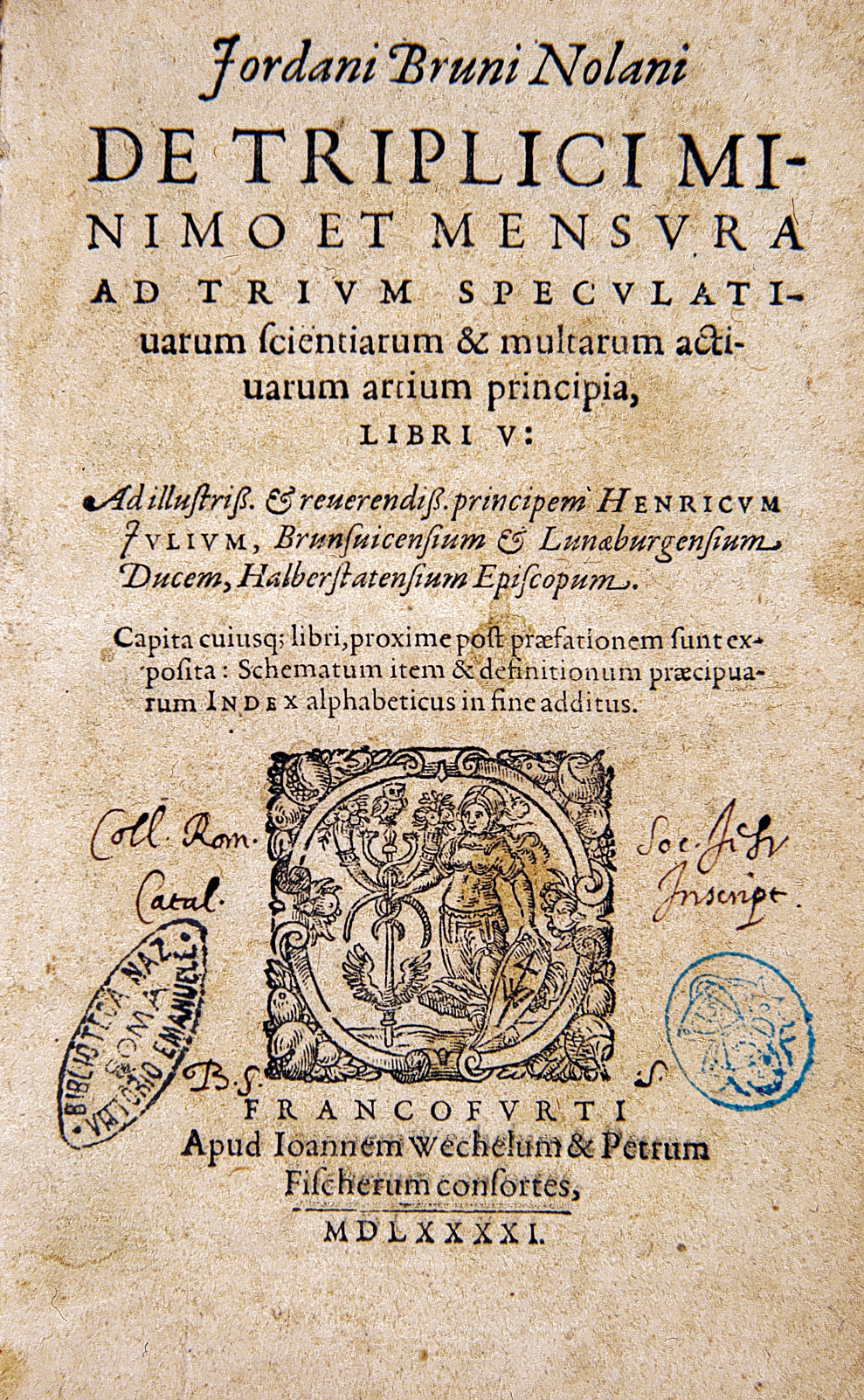
The seventeenth century opens with the burning of Giordano Bruno, condemned by the Roman Inquisition for numerous crimes, among them his assertion that the Universe is infinite and his adherence to Copernican views, and it closes with the publication in France of Bernard Le Bovier de Fontenelle’s Entretiens sur la pluralité des mondes (1686), the posthumous printing in the Netherlands of Christiaan Huygens’s Kosmotheoros (1698), and the spread in England of the physico-theology of the Newtonians. These key events mark the affirmation of a process that had begun in the previous century: the slow but definitive abandonment of the traditional image of the Aristotelian-Ptolemaic Cosmos. A process certainly grounded in and accompanied by the enormous development of mathematical theories and astronomical observations (one need only think of the works of Copernicus, Brahe, Kepler, Galileo, and Newton), but one that at the same time requires a profound transformation in the image of the world as a whole, involving theological doctrines, philosophical theses, and even elements of common sense.
“From the closed world to the infinite Universe”: the evocative formula employed by Alexandre Koyré (1957) in a justly famous essay, while it has the merit of highlighting a fundamental aspect of this process – the passage from the Aristotelian world, ordered and finite, to the open Universe of the Cartesians and Newtonians – nevertheless remains silent on another element, equally important from a cosmological and philosophical perspective, namely the rejection of a hierarchically structured world in favor of a wholly homogeneous and uniform Cosmos. Moreover, the culmination of this process, at least in the seventeenth century, is a Cosmos no longer closed and of immense dimensions, but for the most part not infinite. For essentially theological reasons, in fact, most authors preferred to speak not of infinity but of a plurality of worlds, thereby embracing a hypothesis that made it possible to accept the new image of the Universe without risking the attribution of infinity – a property belonging only to God – to a created being.
At the beginning of the century, the prevailing cosmological model remained the Aristotelian-Ptolemaic one: the world is finite, geocentric in structure, divided into two sharply distinct zones – one, the elemental region, subject to generation and corruption, governed by rectilinear motions; the other, the celestial realm, composed of aether or the fifth element, perfect and incorruptible, and the domain of circular motions. This world requires complex geometric models to account for the motion of the stars, whose real existence in the heavens, however, was debated among astronomers. Most physics and astronomy manuals repeated Aristotle’s arguments in favor of the finitude of the Universe and the uniqueness of the world: the notion of an infinite quantity or an actually infinite body is contradictory and leads to insoluble aporias. By contrast, a magnitude that is infinite in potential – growing indefinitely by addition – is perfectly conceivable. Even this hypothesis, however, is ruled out in the case of our world, both because it would conflict with Aristotle’s notions of place and natural motion and because the sphere is the most perfect and capacious of all geometric figures.
Nevertheless, alternative cosmological hypotheses had already circulated in antiquity: for Epicurus and the atomists in general, the Universe was infinite and composed of an infinity of worlds (that is, systems including an Earth, the planets, the Sun, and the fixed stars). For the Stoics, by contrast, the Cosmos was indeed infinite, but its structure envisaged a single world immersed in an infinite space. Finally, Plutarch, in two celebrated dialogues – De defectu oraculorum and De facie in orbe Lunae – argued in favor of the plurality of worlds (not their infinitude, which he considered incompatible with divine providence), contesting Aristotle’s demonstrations of the world’s uniqueness. The great movement of rediscovery of the ancient Classics between the fifteenth and sixteenth centuries soon brought to light and disseminated these and other texts – such as Seneca’s Naturales quaestiones or Pliny the Elder’s Naturalis historia – which examined hypotheses that clashed with Aristotle’s rigid division between the sublunary world and the celestial world. The classical world thus left an inheritance of four different cosmological models attributable to Aristotle (1), the physiologoi and the Stoics (2a), Plutarch (2b), and the atomists (2c). Summarizing, two different positions emerge concerning the relationship between the world and the whole: for Aristotle (1), the world is the whole, encompassing all existing matter and necessarily unique; for the physiologoi, the Stoics, Plutarch, and the atomists (2), the whole and the world do not coincide. Within this second model, three different positions can be distinguished: (2a) for the physiologoi and the Stoics, the world is unique but surrounded by an infinite substance or space; (2b) for Plutarch, the Universe is finite but composed of multiple worlds; (2c) for the atomists, the Universe is infinite and composed of infinite worlds.
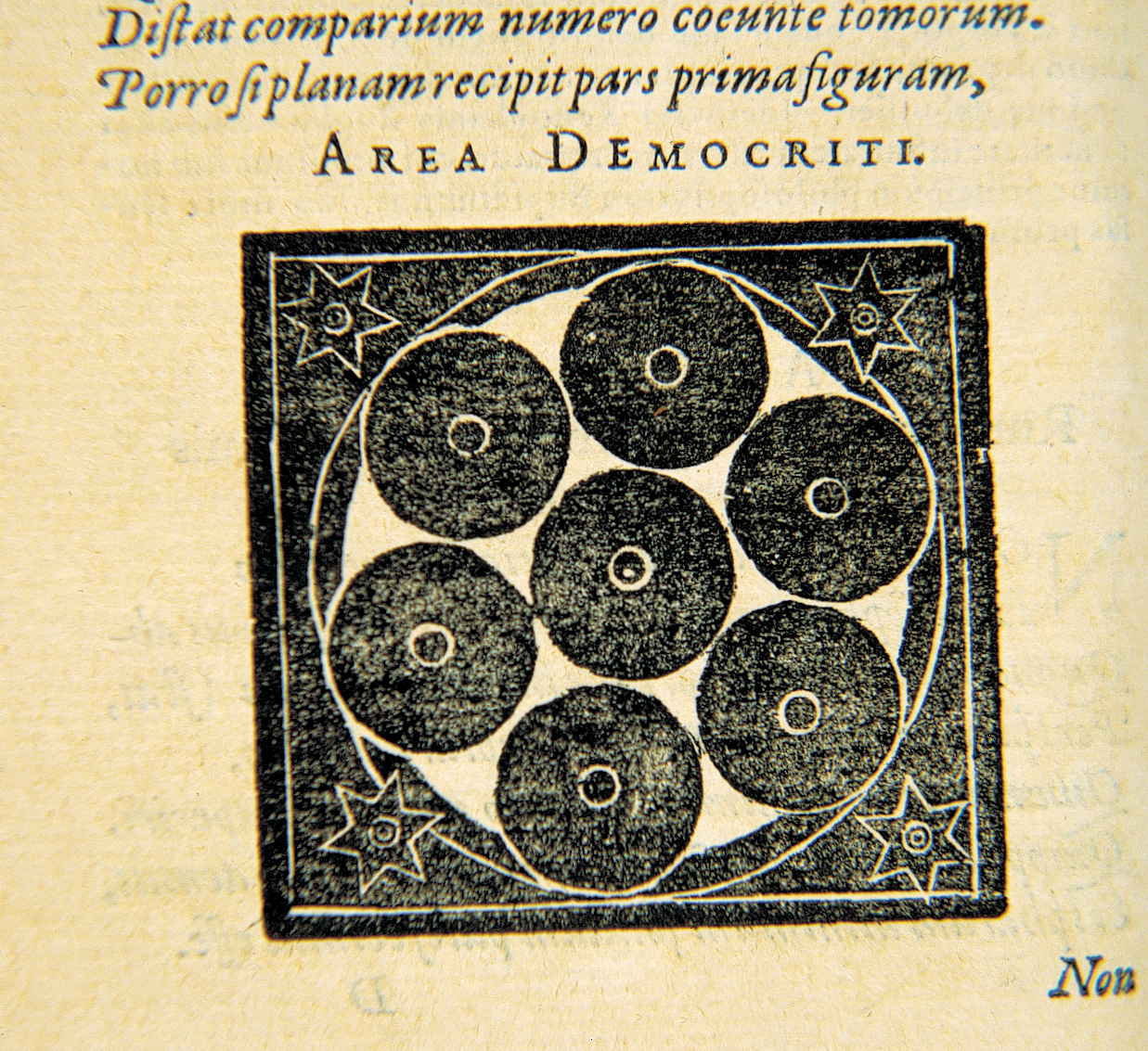
Thus there are two types of infinite Universe (2a and 2c) and two types of finite Universe (1 and 2b), but there are also two groups of proponents of the world’s uniqueness (1 and 2a). Although neither the Stoics nor Plutarch accepted Aristotle’s separation between the sublunary and celestial worlds, in reality only the atomists fully embraced the hypothesis of a uniform Universe: the laws of Nature are the same everywhere (in the De rerum natura, Lucretius uses this argument in favor of the infinitude of worlds), and the entire Universe is composed of the same elements – void and atoms.
Even in Antiquity, the choice between one or the other type of Universe had theological implications, as evidenced by Plutarch’s dialogues, pervaded by a twofold polemic: against the atomists and their deterministic infinitism on the one hand, and against Aristotle and the proponents of the world’s uniqueness on the other, in the name of a divine providence better reflected in a multiplicity of worlds. This aspect, however, would become predominant in the medieval debates, echoes of which can still be heard in the seventeenth century – for example, in the repeated accusation against Descartes that he rejected the theory of possible worlds. From the thirteenth century onward, but with greater intensity in the following century, both the masters of the Faculties of Arts and theologians grappled with a series of problems bearing cosmological implications, which can be grouped under four main questions: the existence of imaginary spaces; God’s ability to create an actually infinite quantity; the possibility of a plurality of worlds; and the possibility of a world different from and better than our own. These hypotheses were discussed not only in commentaries on Aristotelian texts but also in theological treatises – a fact that partly determined the type of answers given: more faithful to Aristotelian orthodoxy in the former case, at least in the thirteenth century, and sometimes openly critical of Aristotle in the latter case, especially in the fourteenth century. The prevailing character of these debates, however, was distinctly theological: they did not aim to determine the actual structure of the real world, which generally remained Aristotelian-Ptolemaic, but rather to examine the possible limits of divine omnipotence and action, and to safeguard God’s freedom from any possible constraint. Consequently, despite the extreme logical and mathematical sophistication displayed by medieval philosophers and theologians, physics and astronomy were scarcely involved in this re-examination of the Aristotelian paradigm. Nonetheless, by the end of the fourteenth century it was clear that if our world is unique and finite and has a geocentric structure, this is the result of God’s free choice, who could have acted otherwise. The condemnation pronounced in 1277 by the bishop of Paris, Étienne Tempier, against those who restricted divine freedom by denying God’s ability to create multiple worlds or to move our world in a straight line, established definitively the limits that were not to be crossed by anyone discussing these matters.
The extent of the changes that occurred is illustrated by comparing the positions of Thomas Aquinas with those of William of Ockham. In his commentaries on Aristotle’s Physics and De caelo, Thomas follows the Stagirite’s footsteps rather faithfully regarding the possibility of a finite body, and the same applies in the Summa theologiae. His strategy concerning the problem of the plurality of worlds, however, is different: far from repeating Aristotle’s argument, Thomas arrives at the same conclusion, driven by entirely different motives. He seeks to demonstrate that the choice of uniqueness is the best: divine action results from a complex concatenation of omnipotence, wisdom, goodness, and will that can lead only to the uniqueness of our world. By contrast, God could create a world different from and better than ours, because, in Augustinian terms, it is true that a creature is good and perfect simply because God has decided to create it, and not that God decides to create a thing because it is good and perfect.
If we examine Ockham’s commentary on the Physics and on the Liber Sententiarum, we find that the situation had changed. Like Thomas, Ockham believed that God could not create infinite quantities in actuality. But his attitude toward Aristotle was decidedly critical: the arguments put forward by the Stagirite to refute the proponents of an infinite universe were not, in his view, conclusive or compelling. Moreover, in rejecting the theory of the plurality of worlds, Aristotle often relied on his own physical doctrines, particularly those concerning places and natural motions. Ockham considered this procedure illegitimate: from a physical point of view, he maintained, it is entirely possible that multiple worlds could exist. The elements of these other worlds would remain in their proper order without moving toward those of our own, and it is perfectly conceivable that God could create more matter than He created for our world, arranging it differently. That the existence of multiple worlds is possible is confirmed, for Ockham, by an examination of divine omnipotence: unlike Thomas, the English philosopher did not analyze the interaction among the divine attributes but focused instead on power, reaching different conclusions.
The desire to safeguard God’s omnipotence and freedom thus led an increasing number of philosophers to conclude that Aristotle’s physical and cosmological theses were contingent rather than necessary – that is, the result of a free divine choice. This conviction opened the way for imagining cosmological structures different from the Aristotelian-Ptolemaic one. A striking example is that of Nicole Oresme who, in the Livre du ciel et du monde, considered the hypothesis of Earth’s rotation on its own axis. The diurnal motion of our planet would allow a simpler explanation of phenomena, eliminating the complex mechanisms required by the traditional doctrine. These advantages, however, did not seem sufficient to Oresme to abandon the theory that places an immobile Earth at the center of the world – a theory which, in his view, accorded with both natural reason and Scripture. During the fourteenth century, authors such as Gregory of Rimini and Jean Mair also challenged another pillar of Aristotelian physics: the impossibility of an actual infinite. Their treatises, however, focused – significantly – not on the dimensions of the universe but on the analysis of continuity and, though employing extremely complex logical and mathematical tools, were of little relevance to cosmological debates.
While debates about the possibility of an infinite body and the theory of the plurality of worlds arose and developed entirely independently of the data provided by astronomical observations – which remained essentially the same as those available to the Ancients – the controversies about the fluidity of the heavens and their composition, which marked the end of the sixteenth and the beginning of the seventeenth century, though with fifteenth-century antecedents, received a decisive impetus from the study of comets and the novae that appeared at the close of the sixteenth century. The growing favor enjoyed by non-Aristotelian philosophies was of no small importance: it is no accident that a Platonist such as Marsilio Ficino made the spiritus the substance of the heavens, abandoning the traditional division into spheres and, at the same time, enabling a rapprochement between Earth and heaven. The spiritus was, in fact, omnipresent and the mediator that allowed interaction between soul and body – even in human beings. Its function was thus essential for enabling the ascent to the celestial world that characterized the ‘genius’. A similar role was played not only by Stoic doctrines and those of Paracelsus but also by the desire to adhere to biblical teaching; an example is the discussion between Tycho Brahe and Christoph Rothmann on the nature of comets (see Box 1).
It now seems clear that Brahe did not reach, either immediately or in a linear fashion, the conviction that the heavens were fluid. Although he had already established that the comet of 1577, being without parallax, could not be located below the Moon, as Aristotelian philosophy maintained, there is no trace of an immediate rejection of the existence of celestial spheres. This rejection appeared much later – first privately, in his 1586 correspondence with Rothmann, and then publicly in the De mundi aetherei recentioribus phaenomenis (1587) – and was motivated not only by mathematical arguments but also by a series of biblical citations attesting to the fluidity of the heavens. Brahe, however, absolutely refused to accept Rothmann’s other conviction: that the nature of the heavens was similar to that of air. For the Danish astronomer, celestial matter was more perfect than terrestrial matter; it was not subject to generation and corruption and could still rightly be called ether or quintessence, as Aristotle maintained. Not surprisingly, Brahe regarded the nova of 1572 as a miraculous event, while Jerónimo Muñoz, a student of Stoic philosophy and admirer of Seneca and Cicero, immediately inferred from the appearance of the nova the airy nature of the heavens and their corruptibility, in his Liber del nuevo cometa (1573).
The end of the sixteenth century, however, also bequeathed to the following century hypotheses that completely overturned the traditional image of the world. There were authors who did not merely abandon the Aristotelian doctrine of quintessence and the division of the heavens into multiple spheres but went so far as to abolish the sphere of the fixed stars, clearly affirming that the universe was infinite. Their cosmological models were not entirely equivalent, and this allowed them to enjoy varying degrees of success during the seventeenth century. Examining the transition from medieval discussions of the possibility of actual infinity and the plurality of worlds – always purely speculative and never intended to describe an actual state of affairs – to the firm assertion of the infinity of the universe, we find that in at least two cases this conviction did not result from adopting the Copernican system – which, astronomically, rendered the sphere of the fixed stars superfluous – but rather from the revival of certain arguments advanced by the Stoics and Epicureans and, above all, from a different conception of divine omnipotence, based on what Arthur O. Lovejoy (1936) called the ‘principle of plenitude’. For most medieval philosophers, divine omnipotence was such only insofar as it remained inexhaustible; for Marcello Palingenio Stellato and Francesco Patrizi, it could manifest itself only in an infinite action that generated an equally infinite world. According to the ancient Platonic dictum bonum effusivum sui est, nothing could hinder the manifestation of infinite divine goodness. The application of these principles allowed the passage from the hypothetical to the real, which, in this respect, marked the dawn of the modern age.
A closer look at the cosmological models proposed by these two philosophers, however, reveals immediate and important differences. Palingenio’s Zodiacus vitae is permeated by a profound opposition between the sage and the common man, between humans and the inhabitants of the stars, between Earth and heaven. His adherence to geocentrism signals a deep contempt for the worldly condition of human beings, who are closer to hell than to heaven. It is therefore unsurprising that this dualism was reflected in his cosmological structure: Palingenio, in fact, explicitly followed Aristotle in rejecting the idea of an actually infinite body. His cosmos was Stoic in type: an infinite space, filled with incorporeal light and inhabited by immortal intelligences, at whose center lay the physical world proper. Moreover, this physical world was itself divided into an ethereal region, located between the Moon and the fixed stars – also inhabited by immortal beings – and the Earth, surrounded by the spheres of the elements. Equally traditional was his appeal to celestial spheres and his assertion that only the Sun possessed light of its own.
If we turn to Francesco Patrizi’s Nova de universis philosophia (1591), we find strong similarities with Palingenio’s universe, although in this case the philosophical framework is Platonic. From God emanate four entities: space, light, heat, and fluidity. All infinite, these emanations are not on the same level but approach matter progressively, which occupies their center with the physical world proper. Patrizi developed, drawing on the Ancients, a concept of space that can rightly be called modern and which, later taken up by Pierre Gassendi, exerted an influence even on Isaac Newton. Space is defined as continuous, immobile, homogeneous, endowed with incorporeal dimensions, and alien to Aristotle’s division of entities into substances and accidents. Yet, on closer inspection, homogeneity in Patrizi’s conception of space is not absolute: the infinite space of the Nova de universis philosophia has a center, and its properties are modified by the presence of the world within it, since he concludes that there are two kinds of space: the finite space occupied by the world and the infinite space extending beyond the heaven of the fixed stars. A form of heterogeneity thus remains present even in Patrizi’s cosmos.
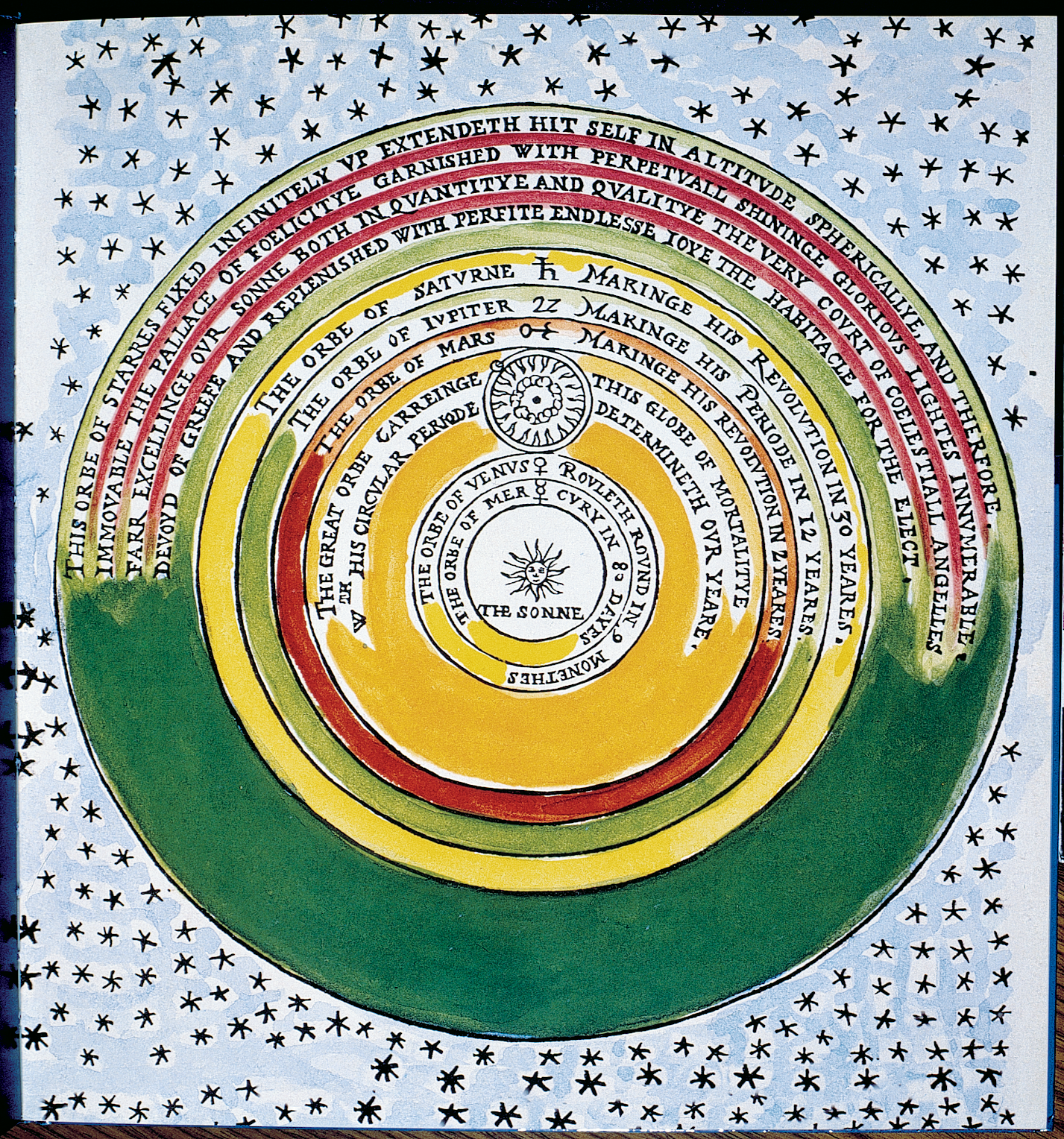
Astronomers themselves did not entirely free themselves from a hierarchical vision of the world. Emblematic are the cases of Thomas Digges and Raymarus Ursus. The former, a Copernican, conceived – and, more importantly, depicted – an open universe, in which the sphere of the fixed stars no longer exists and the stars extend to infinity beyond Saturn’s orbit. His is a ‘theological heaven’, the seat of God’s court, rather than a physical entity. The latter, competing with Tycho Brahe for the title of inventor of the geo-heliocentric system, diverged from the Danish astronomer’s convictions because he believed that the stars could lie at immense distances from Earth and that the heavens were composed of air. Yet he then made our planet the center of magnetic attraction for all heavy bodies, placed it at the center of the universe, and regarded it as the only composite body, while the stars were simple bodies. At times, his pages seem to echo the profound anthropological pessimism of Palingenio, with its contempt for the tiny and miserable world we inhabit and for the vanity of the spectacle that humans offer to the blessed inhabitants of the heavens.
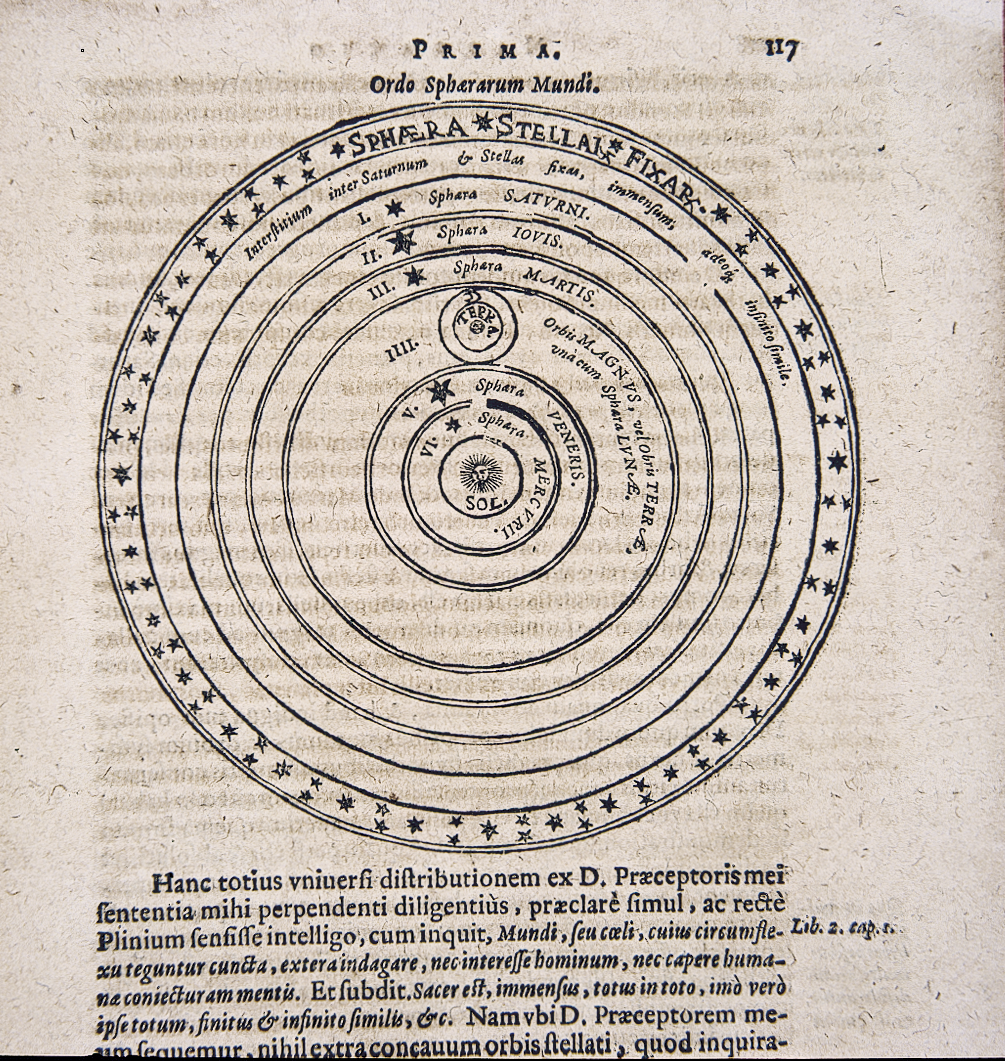
Compared to these cosmological models – all tending toward the abolition of the sphere of the fixed stars but all marked, to a greater or lesser degree, by forms of heterogeneity – the anomaly represented by Bruno’s thought at the end of the sixteenth century and the importance of his legacy in the following century become even more evident. Bruno inherited and employed a complex set of arguments for the infinity of the universe, drawn primarily from the infinitist theses refuted by Aristotle and his commentators, but also from Nicholas of Cusa and Lucretius. The concept of space played a fundamental role: Aristotle’s definition of place was unacceptable for the world as a whole, and the only way to extricate oneself from a series of otherwise insoluble contradictions was to adopt a concept of space understood as an infinite and, perhaps even more crucially, uniform entity. While the analogies with atomistic doctrine are obvious, one must also take account of the differences: for Bruno, space was not absolute void but ultimately coincided with the ether. In the De immenso (1591), Bruno adopted John Philoponus’ considerations on space: it is a continuous quantity, which precedes corporeal things by nature, indifferent to what it contains, impenetrable (that is, not separable into parts), an entity that encompasses everything and is encompassed by nothing, and which is neither substance nor accident.
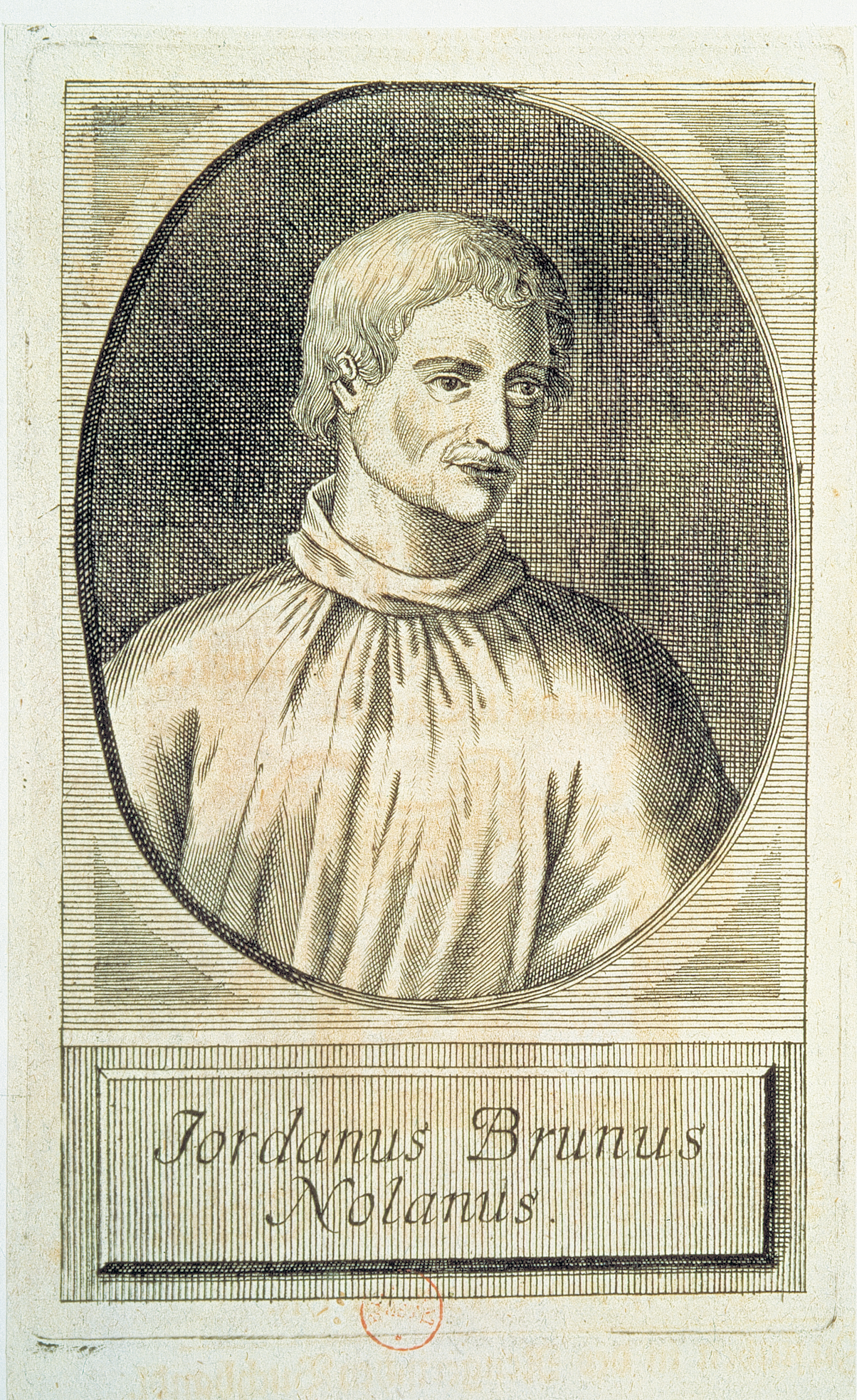
It is precisely the absolute uniformity of space that enables Bruno to reach conclusions very different from those of Patrizi and Palingenio, whom he explicitly criticizes in his works: space is homogeneous, and what exists in one region must also exist elsewhere. If, therefore, one region is occupied by our world, other regions must likewise contain similar worlds – and by worlds Bruno means both other inhabited planets and other solar systems. He offers us the image of a cosmos governed by a double analogy: dethroned from its seat at the center of the universe, Earth is similar to the other planets orbiting the Sun, which also means that planets are ‘earths’, that is, they share a composition similar to that of the celestial body we inhabit and are likewise inhabited; the stars are nothing more than suns, each at the center of the orbits of planets invisible to us due to their immense distance. The universe is therefore composed of the infinite repetition of systems similar to one another, much as in the cosmological model proposed by the atomists; but these systems are heliocentric, cannot have forms and structures entirely different from our own – by virtue of the principle of uniformity – are interconnected, and are not isolated by intermundia. Aristotelian physics is completely abandoned: there are no longer any natural places toward which the elements move; rather, every motion is dictated by the desire of bodies to preserve themselves.
What defines motion as natural or violent is no longer, as Aristotle maintained, whether it is circular or rectilinear, but whether it has an internal or external mover: when the mover is internal, motion is natural. The distinction between circular and rectilinear motion derives instead from that which differentiates the whole from its parts. The bodies constituting a whole move in circles: they rotate on their own axis or around their suns in an effort to maintain the balance between the moist and fiery elements; their parts, on the other hand, move in straight lines when attempting to return to the whole from which they have been separated or, if the distance becomes excessive, to reach another whole that can guarantee their preservation. This last point marks the difference from Copernicus: the parts of a planet behave like a mechanical system and thus participate in that planet’s rotation not because they share its nature, but simply because they are on it. If, then, we were to take a stone from our planet and place it between the Moon and the Earth, it would not automatically return to its place of origin but would move toward the celestial body most capable of ensuring its preservation. It follows that, although stars and planets are living organisms, their parts are not specifically ‘terrestrial,’ ‘lunar,’ or ‘jovian’; indeed, even among planets and stars the difference in composition is quantitative rather than qualitative. The planets are stars in which the watery element predominates, whereas in the stars the fiery element prevails; in contrast to traditional astronomy, and in agreement with Nicholas of Cusa, Bruno held that both planets and stars are composite bodies and that there are no simple bodies (see Box 2).
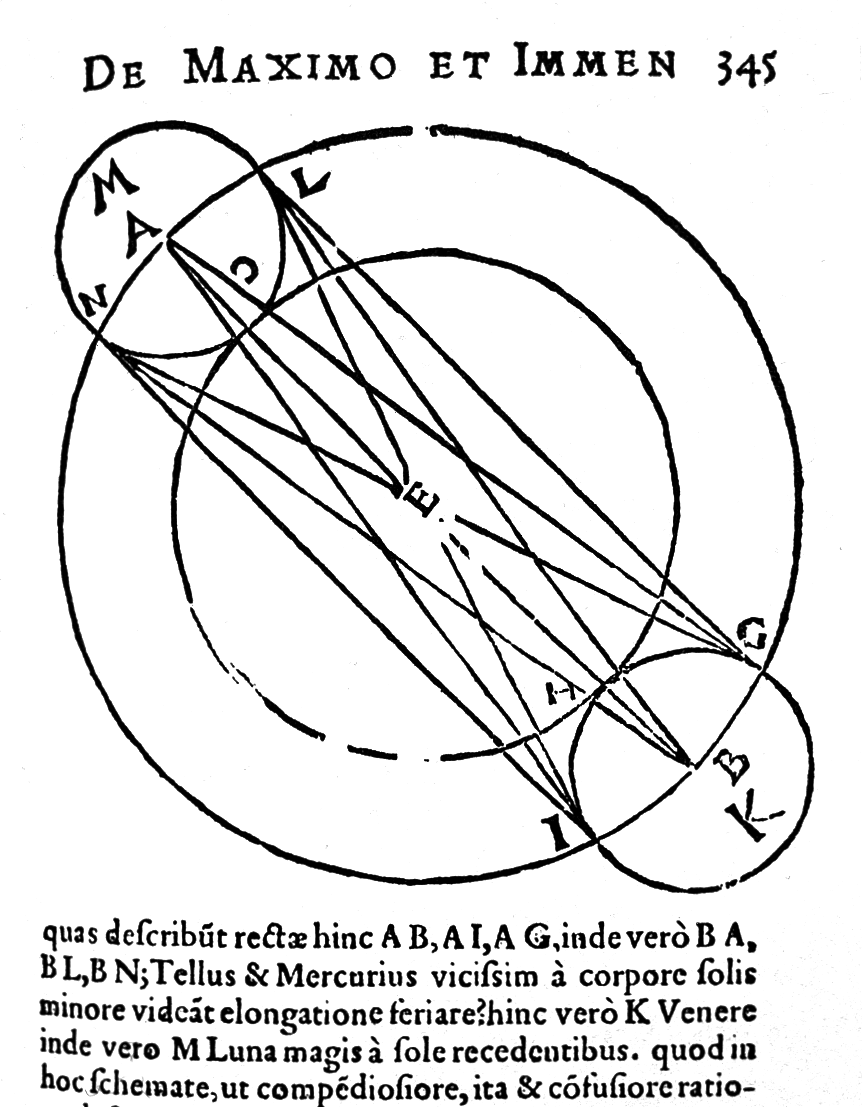
This framework also accommodates the most extraordinary celestial events, such as comets, which, far from being ephemeral or miraculous phenomena, are genuine planets orbiting the Sun, visible only periodically because of their particular inclination relative to the ecliptic, which prevents their watery surface from constantly reflecting sunlight. Perhaps it was this desire to push the principle of the universe’s uniformity to its extreme that led Bruno – especially after 1588 – to elaborate a radical reform of the order of planets in our solar system. Reviving the ancient Pythagorean doctrine according to which Earth was accompanied by an anti-Earth, Bruno believed that the planets are arranged around the Sun in pairs: the first consisting of Venus and Mercury, the second of Earth and the Moon – so that the Moon would no longer be a satellite but a true planet. Devoid of any correspondence with celestial observations, this system, proposed by Bruno as the culmination of the reform initiated by Copernicus and pursued by the most illustrious astronomers of the time, seems to find its justification only in Bruno’s ‘philosophy of history’: the rediscovery of ancient Egyptian and Pythagorean wisdom and the attempt to avoid hierarchical subordination within the universe eliminate every distinction among comets, satellites, and planets other than that between watery and fiery bodies.
The rehabilitation of atomistic cosmology and the rejection of Aristotelian physics constitute only one aspect of Bruno’s philosophy. Another fundamental element emerges from his consideration of the second proof of the universe’s infinity, which he shared with Patrizi and Palingenio. The ‘passive power of the universe’ and ‘the active power of the efficient cause’ are one and the same thing; an infinite cause cannot fail to produce an infinite effect; God cannot remain idle. Underlying these theses is not only the identification of freedom and necessity but also a sharp repudiation of the dogma of the Incarnation. For Christian doctrine, God fully manifests his omnipotence ad intra by reflecting himself in the persons of the Trinity, while his activity ad extra – Creation – produces a finite effect. For Bruno, by contrast, the true image of God is not the incarnate Son but the universe: in forgetting this truth and creating monstrous mixtures of the divine and the human, Christianity consummated the process of decline that began with the diffusion of Aristotelian philosophy. These are the elements that distinguish Bruno from Nicholas of Cusa, for whom the world does not exhaust God’s omnipotence and is the product of his will.
At the beginning of the seventeenth century, the various hypotheses concerning the matter of which the heavens are composed and its degree of uniformity can be grouped into the four models illustrated in Box 3. The transition from one of these models to another did not follow any necessary path, and many combinations were possible. The widespread diffusion of Plutarch’s dialogues and Lucian’s narratives, the impact of Galileo’s telescopic observations – which attributed to the Moon an irregular surface similar to that of the Earth – and the plausibility of the analogy between Earth and the planets, for those who rejected the Aristotelian-Ptolemaic system, soon fostered a doctrine of the plurality of worlds very different from the medieval notion that bore the same name. Scholasticism, as we have seen, had developed a theory that made it possible for God to create Earth-planet-fixed-star systems different from and separate from the one we inhabit, in order to safeguard divine freedom and omnipotence; this doctrine, which never disappeared entirely in the seventeenth century, was accompanied by the hypothesis that other inhabited worlds exist – where by ‘worlds’ one meant planets (or satellites, in the case of the Moon) similar to the Earth, orbiting the Sun or, in some cases, even other stars.
The path that would lead to this conclusion, however, first required the neutralization of Bruno’s theses. His proposal contained two elements deemed unacceptable: it appeared too closely linked to the atomistic tradition, long stigmatized as impious and atheistic, and it grounded the demonstration of the infinity of the universe and planetary systems on a form of theological necessitarianism that entailed the rejection of the dogmas of the Trinity and the Incarnation. Marin Mersenne was the first to denounce this aspect of Bruno’s cosmology explicitly: the second volume of his Impiété des déistes, published in 1624, is largely devoted to refuting the cosmological theses set out by Bruno in De l’infinito, universo e mondi and De la causa, principio et uno (1584). What mattered to the future correspondent of Descartes was to reassert and defend the Christian dogmas: Creation is the product of God’s will, who freely chooses the dimensions of the universe without being in any way ‘compelled’ to make it infinite, and the world cannot in any sense claim to mirror and represent the infinite power of God, which is manifested fully only in the generation of the three persons of the Trinity. These pages set the tone for subsequent discussion, and even those who, like Charles Sorel and Pierre Gassendi, sought to defend the Italian philosopher or silently incorporated certain elements of his thought into their own writings, never questioned divine freedom and remained extremely cautious with respect to the hypothesis of an infinite universe.
There are other reasons that may lead to a rejection of Bruno’s infinite and uniform cosmological model. Although grounded in philosophical and religious considerations, they do not have as overtly apologetic a character as those that drove Mersenne to refute the Italian philosopher. We shall examine the positions of Kepler and Campanella: the former a convinced Copernican, the latter never entirely persuaded by heliocentrism. Both engaged with the new ideas advanced by Bruno and Galileo – ideas that differed greatly in content but were commonly interpreted as a revival of ancient Pythagoreanism.
Kepler repeatedly analyzed Bruno’s doctrines and rejected them with both scientific and philosophical arguments, ultimately arriving at his own highly original proposal for a plurality of inhabited worlds within a cosmos that was neither homogeneous nor infinite. The philosophical reasons that led him to deny Bruno’s infinite universe often echoed the arguments developed by Aristotle and his followers. In the De stella nova in pede Serpentarii (1606), for example, he asserts that an infinite body in act cannot exist because every point would be infinitely distant from the extremes and at the same time would both be and not be the center of the world; or because, however far away we imagine a star to be placed, that distance is still finite, even if it exceeds our ability to measure it. In the Epitome astronomiae Copernicanae (1618), Kepler argues that summing the masses of an infinite number of stars would lead to the paradoxical result of a three-dimensional body of infinite size. Equally absurd is the notion that two bodies could be separated by an infinite line: everything that has two endpoints is finite. Finally, following the commentaries on the Sphaera by Johannes de Sacrobosco, he maintains that the cosmos must be spherical, since a sphere is the most capacious solid and the figure that most closely resembles God – not to mention that otherwise the parts (that is, the stars) would have a more perfect shape than the whole of which they are a part (that is, the universe).
More original are the astronomical considerations Kepler advanced in favor of a finite cosmos. In the De stella nova, the German astronomer observes that, according to the measurements available at the time, the stars have an apparent diameter of two minutes of arc. If they were scattered at great distances from the Earth, they would need to be enormous in size to account for this appearance. As he would later state in the Epitome astronomiae Copernicanae, the hypothesis that stars increase in size in proportion to their distance from Earth contradicts the very principle of uniformity upon which Bruno built his theory. In the same work, Kepler argues that if the fixed stars were equidistant, they would have to be arranged at the vertices of an icosahedron – a solid chosen because in it the distance from the center to a vertex equals the distance between two vertices. After the first twelve stars, there would need to be another twelve at twice the distance, and so on; but such a geometric arrangement cannot account for the vast number of visible stars and their grouping into constellations. Finally, in the Dissertatio cum Nuncio sidereo (1610), he offers yet another argument to show that the cosmos cannot be homogeneous: if the fixed stars were as luminous as the Sun, the night sky would be brighter than the day, since the sum of their apparent diameters would compose a body of magnitude far greater than that of the Sun.
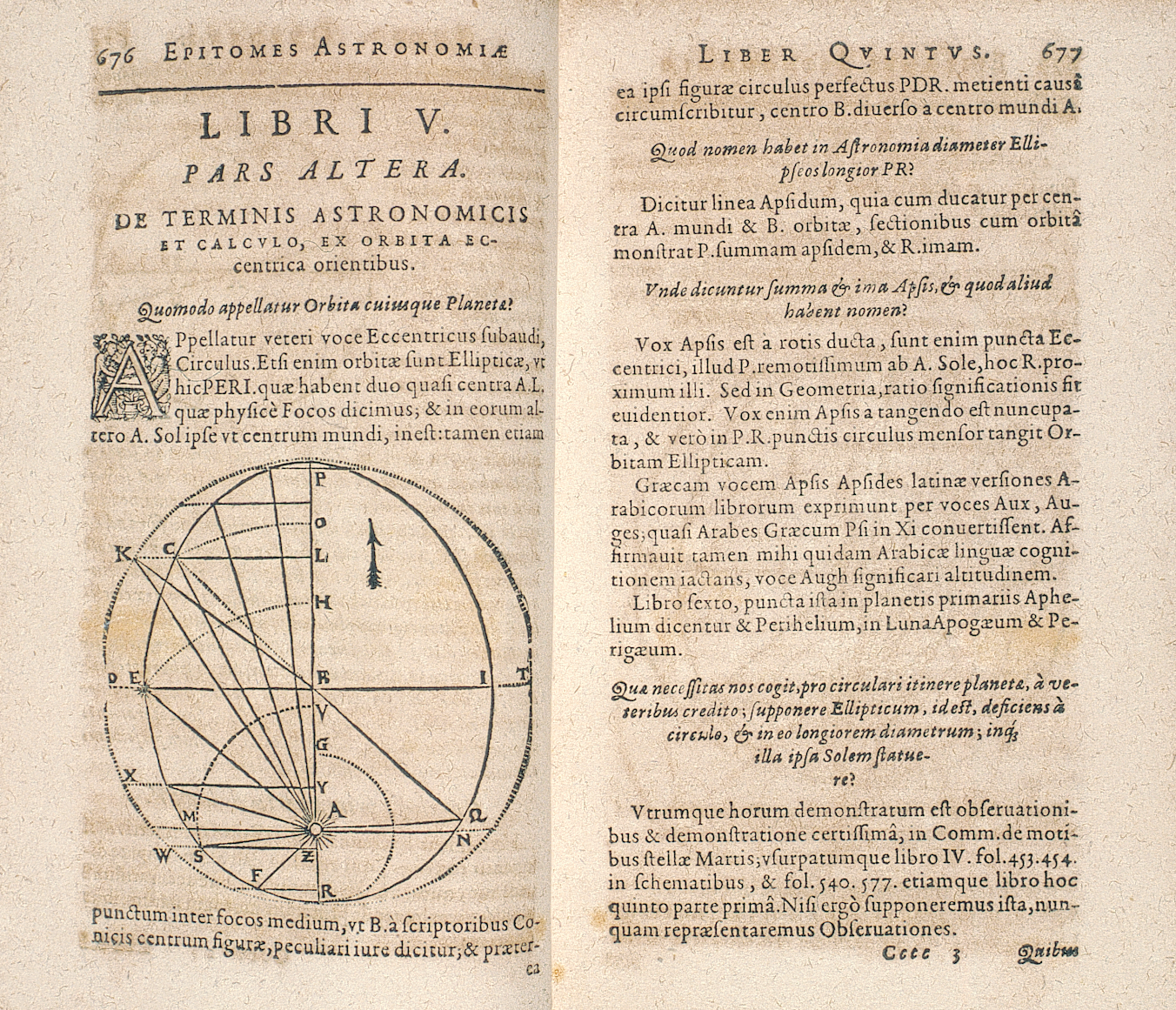
Having rejected Bruno’s solution, what remains is to accept the one devised by Kepler himself: the universe is finite, has a center – occupied by the Sun – and a periphery, formed by a thin sphere of fixed stars. In between lies an immense empty region, inhabited by the planets, which divine wisdom has arranged according to the five Platonic solids. This is a universe not only finite, but also non-uniform. As explained in the second part of the Epitome astronomiae Copernicanae (1620), the quantity of matter contained within the Sun, the empty space extending to the fixed stars, and the outermost sphere must be equal (in accordance with the Trinitarian model alluded to by the frequent analogies in Kepler’s writings). This requirement prevents the stars from being suns.
If this is Kepler’s image of the cosmos as a whole, his reaction to Galileo’s telescopic observations reveals his views on the structure of the solar system. As he recounts in the Dissertatio cum Nuncio sidereo, Kepler initially had only vague news of Galileo’s discoveries – so vague, in fact, that he feared his friend Johann Matthäus Wacker von Wackenfels might be right: the Italian astronomer could have observed planets orbiting other stars, offering experimental confirmation of Bruno’s hypotheses. Kepler, however, discovered with relief, upon reading Galileo’s book, that the observations concerned Jupiter’s satellites. Bruno had predicted the existence of planets (aqueous) orbiting stars (fiery), but not satellites (aqueous) orbiting planets (aqueous): his system, founded on the analogy between the Sun and the stars, was thus undermined by experience. Other Galilean observations also confirmed Kepler’s own claims: the discovery of countless stars invisible to the naked eye reinforced his arguments against an infinite universe (although he had to admit that the fixed stars resemble the Sun, since they emit their own light), while the ‘earthly’ nature of the Moon, revealed by the telescope, supported views Kepler had expressed as early as a university disputation in 1593. The only point on which he had to correct himself concerned the interpretation of lunar spots. Galileo had demonstrated, through telescopic observations, that the Ancients were right: the dark areas are seas, and the bright parts land.
Constantly blending data from astronomical observations with theses drawn from literary and philosophical traditions – as he would later do in the Somnium – Kepler launched into a series of conjectures about the nature and characteristics of lunar inhabitants: they must be much larger than we are, given that lunar mountains are higher than those on Earth, and capable of monumental works if, as seems likely, they are responsible for the enormous circular cavity visible at the left edge of the Moon’s ‘mouth’. Such works must surely be intended to shield them from the scorching heat that burns during the long lunar day, despite the rains that partly mitigate the climate. Still richer in observations about lunar life is the Somnium seu opus posthumum de astronomia lunari, a work whose first sketches date to 1593 and which was written between 1609 and 1620, before being published posthumously in 1634. Its didactic intent (to provide arguments in favor of the Copernican system) is evident in remarks such as those concerning the fact that the Lunarians, too, seem to themselves to stand still at the center of the universe, or that they must have developed a planetary astronomy completely different from ours, since the motions of the planets appear to them entirely unlike those that we observe. The description of lunar inhabitants is dominated by the need to adapt life to the excessive heat that must characterize the lunar day: living beings either dwell in the depths of the seas, which remain cool even when the surface boils, or spend the day in caves and emerge only at night to feed. The need for sun protection means that they all have an exceptionally thick skin, which burns and peels off when exposed to sunlight. Some of them behave in the opposite way to flies: during the intense heat of day, they lie inert and begin to move again when night brings coolness.
Autobiographical elements (Kepler’s mother had narrowly escaped a charge of witchcraft) and literary reminiscences (especially from Plutarch’s De facie in orbe Lunae, whose translation accompanies the Somnium) ensure that this otherwise imaginative portrayal of lunar life includes magical and mystical doctrines: the narrator of lunar geography and life is a demon who dwells in the Earth’s shadow cone and uses eclipses to descend to the Moon. Strongly allegorical though they are, as Kepler’s own notes clarify, these pages of the Somnium combine two different traditions: one that regards the inhabitants of the stars as superior beings, and another that imagines them, mutatis mutandis, as of our same nature and similar to us. A narrative device in the Somnium, this oscillation will later reappear with far greater force and significance in Tommaso Campanella.
The Moon is not the only celestial body that Kepler believed might be inhabited: in the Dissertatio cum Nuncio sidereo, he also argued for the existence of inhabitants on Jupiter. In the case of the Moon, this theory had been advanced on the basis of supposed physical and geomorphic similarities between this body and the Earth (presence of mountains, seas, atmosphere, rainfall) and on the observation of surface features so regular as to appear artificial. The analogy between the Earth and the Moon (reinforced by Galileo’s observations) was extended to the possibility of inhabitants on our satellite. The hypothesis of extraterrestrial life thus derives from the principle of Nature’s uniformity, which recalls the formulations of Lucretius: where Nature employs similar causes, one should expect similar effects. In the case of Jupiter, however, the reasoning rests entirely on teleological considerations, perhaps due to the scarcity of experimental data; and it is worth noting that Kepler did not hesitate to include such speculations in a text that, while not a strictly scientific treatise, was certainly no mere ludus. For the German astronomer, it cannot seriously be maintained that the Medicean planets were placed around Jupiter propter nos, not even in the broadest and vaguest sense of that phrase – namely, to delight and instruct us with their periods of rotation and revolution: we have only just discovered them, and only a handful of men can see them with the aid of the telescope. The only possible conclusion is that they fulfill this purpose for the inhabitants of Jupiter.
At this point, however, a serious problem arises for Kepler: if we admit that another planet of our solar system is inhabited, do we not risk falling back into Bruno’s error – albeit in a milder form – namely, the obliteration of every spatial hierarchy, now grounded not in a metaphysical distinction but in a geometrical arrangement of bodies in space? The need to demonstrate man’s superiority over every other creature drives Kepler to reconsider once more the ultimate symbol of all relativism – Bruno’s infinite universe – before proposing a solution to the problem. This leads, on the one hand, to a variant of a Thomistic argument: other worlds would be either similar to ours or different. If similar, this infinite repetition would be pointless, since each would already be perfect; moreover, an infinite regress would be unavoidable, and we would fall into the absurdity of imagining countless Galileos simultaneously observing new stars in those worlds. If different, the difference would lie in the geometrical arrangement of their components; but the structure of planetary orbits would not follow the pattern dictated by the five regular solids, which would render them inferior to our own system.
On the other hand, the Earth’s preeminence within our solar system derives from the geometrical structure laid out in the Mysterium cosmographicum (1596). The most noble position in the system is occupied by the Sun, cor mundi. Next comes the Earth: it lies at the midpoint among the celestial bodies (Sun–Mercury–Venus and Mars–Jupiter–Saturn); its orbit separates the two classes of Platonic solids (cube–tetrahedron–dodecahedron and icosahedron–octahedron); and its intermediate position allows humans to observe all the planets of the system (Mercury, being so small and so close to the Sun, must be invisible from Jupiter), thereby enabling us to discern the divine signature in Nature – its geometrical order.
To summarize, Kepler’s reaction to Bruno’s theories is driven by the same concerns that motivate Plutarch’s interlocutor in the De defectu oraculorum: in both cases, the aim is to transcend the Aristotelian cosmological model while opposing the impious materialism of the atomists or of Bruno. It is essential to maintain the presence of divinity in the world and to display its providential action through the seal of Nature – its order. For Plutarch, this aim is achieved by denying that worlds can arise from the fortuitous collision of atoms; for Kepler, by attributing to the cosmos a geometrical structure that both attests to God’s creative intervention and excludes an infinite universe. The imperfectly homogeneous distribution of the stars is thus a necessary condition for man to navigate among them, exercising his imaginative and rational faculties, while the architecture of the solar system assigns the Earth a privileged position. Kepler’s God not only constructs the system according to the Platonic solids and reserves the place of honor for us, but also arranges the stars so as to make this region of the universe unique, enabling man – created in His image and likeness – to read and appreciate His handiwork.
It is not easy to determine Campanella’s view of the universe’s structure. What survives of his work is often the result of countless rewritings, composed almost entirely in prison, which sometimes reveal the text’s layered composition and the author’s changes of mind. We cannot know how much reflects deep conviction and how much represents a compromise, an attempt to avoid worsening his situation as a closely monitored prisoner while still giving voice to his opinions. A staunch Telesian, Campanella begins from positions extremely remote from Copernican heliocentrism: the fiery element, concentrated primarily in the Sun but present also in the heavens, causes the motions of all the stars; the earthy element, whose seat is our planet, remains motionless at the center of the universe. Moreover, in the De sensu rerum, the stars, including the planets, are perhaps moved by true souls and are certainly the dwelling places of the blessed, while in the Atheismus triumphatus this same belief plays a major role in theodicy, since the perfection of the stellar inhabitants mitigates – at least quantitatively – the presence of physical and moral evil on Earth.
Despite these premises, the Calabrian philosopher’s reaction to Galileo’s observations, reported in the Sidereus nuncius, is almost enthusiastic; and even later, his expressions of esteem and friendship toward the Pisan scientist would be numerous. In a letter sent to Galileo in January 1611, Campanella immediately establishes a link between Galilean heliocentrism and a model of cosmic uniformity that allows for the hypothesis of extraterrestrial life forms very similar to those on our planet – so similar, in fact, that the same issues concerning the salvation of souls would arise for the inhabitants of other stars as they do for human beings.
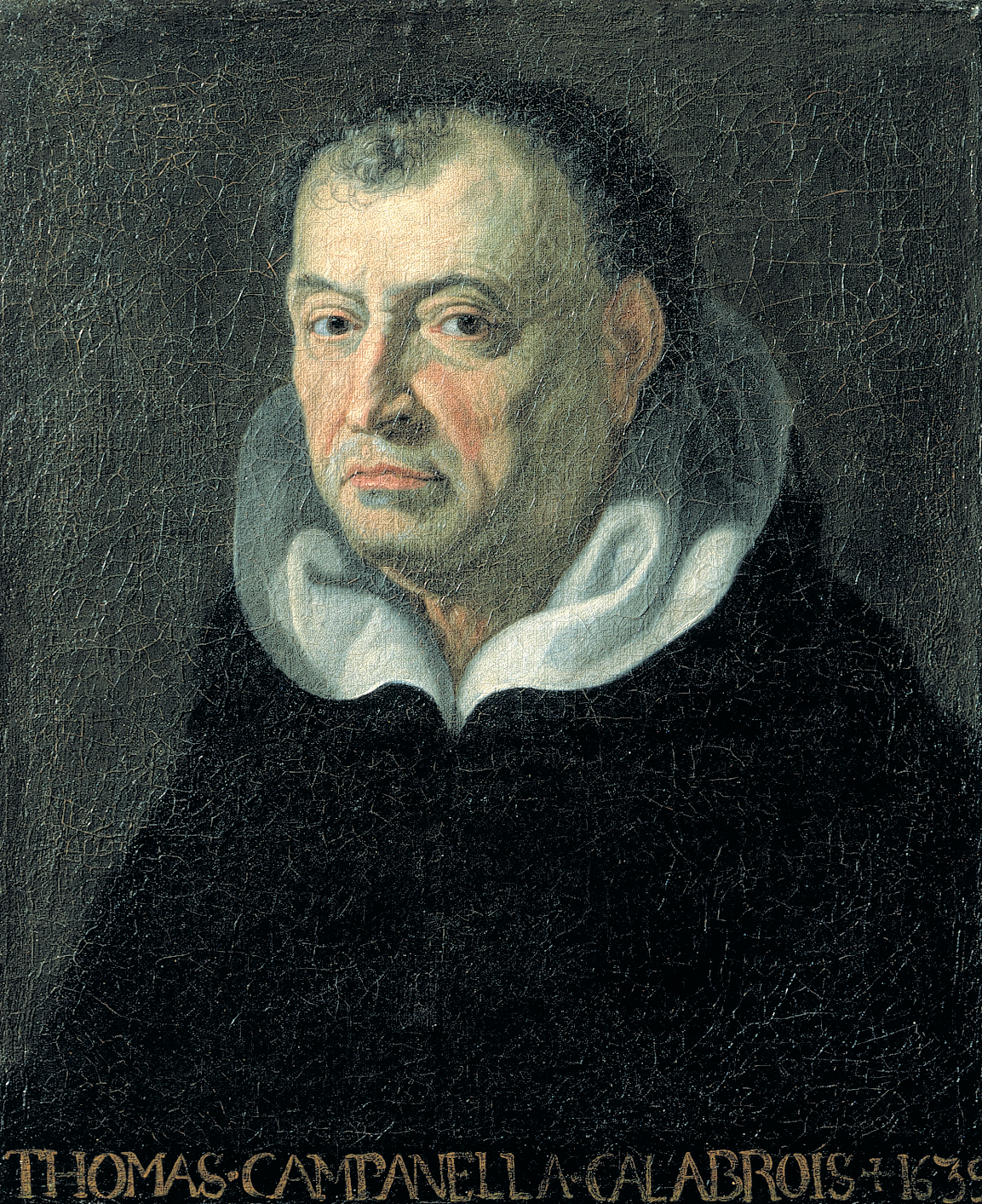
Campanella perfectly understood that the cosmology proposed by the “Pythagoreans” not only envisages an open universe, in which Earth no longer occupies the center, but also assimilates the stars to the Sun. Paradoxically, it is precisely this element that Campanella will always refuse to adopt. In the Metaphysica (1637), for example, he declares that, had it not been for the ecclesiastical condemnations of 1616 and 1633, he would have been willing to introduce a remarkable series of changes to his original Telesian framework: he would have definitively accepted the composite nature of the stars; the analogy between Earth and the other planets; the fixity of the firmament; the presence of planets orbiting other stars; and the absence of a center, and therefore of any absolute notions of “up” and “down.” He would even have been willing to abandon the connection between cosmology and theodicy, provided that the link between the uniqueness of the world (albeit divided into multiple systems) and the uniqueness of God remained intact. Only on one point does he reaffirm his dissent: the stars cannot be entirely similar to the Sun because they emit colored light, which demonstrates that they are not composed solely of fiery matter like our star but are of composite nature. This does not preclude them from being the centers of planetary systems, since even Jupiter is surrounded by satellites.
Like Kepler, Campanella cannot refrain from invoking Bruno’s theories when considering the hypothesis of a uniform universe. Evidence of this is found in the Apologia pro Galileo (1622), where the name of the Pisan scientist is associated with that of Bruno. Once again, however, Plutarch serves as the authoritative source that allows Campanella to differentiate Brunian infinitism from Galileo’s vast cosmos: according to Campanella, the latter does not follow in the footsteps of the atomists because it admits the existence of order in the universe. In short, Galileo’s multiple systems coalesce into a whole in which the divine hand is discernible. Indeed, the doctrine of the plurality of worlds permits a literal interpretation of the Bible in all those passages that contradict the Aristotelian theory of the incorruptibility of the heavens, and it aligns with the Parisian decree of 1277, which condemned those who denied God’s power to create multiple worlds. Campanella can now turn to another problem: the theological implications of the possible existence of inhabitants on other planets. Three escape routes are available to avoid the most openly heretical consequences of the hypothesis of inhabited worlds, and Campanella explores them all: to maintain that the inhabitants of other planets are not human and that their relationship with God follows paths different from those described in the Bible; or to claim that, even if they are human like us, their progenitors did not incur original sin; or else to propose that Christ’s sacrifice on Earth suffices to redeem all extraterrestrials. The first solution is the one almost universally accepted in the seventeenth and eighteenth centuries, and it is also the one Campanella favors in other writings. Its advantage is that it makes possible a discussion about the existence and characteristics of extraterrestrials without requiring engagement in biblical exegesis. In the Realis philosophia epilogistica (1623), Campanella returns to this same issue, adding significant nuances that are of interest because they will reappear in Gassendi’s Syntagma philosophicum. First, he invokes divine power and wisdom – inscrutable and infinite – which might explain both the existence of extraterrestrials and the means of their redemption. Second, Campanella seems strongly inclined to affirm the existence of beings that are not human: the climates of Earth give rise to human races that differ greatly from one another, and the climatic differences on other planets must be far greater than those observed on ours. This suggests that their inhabitants are so radically different from us that they cannot be considered human but belong instead to kinds distinct from ours – perhaps superior (a notion that opens the way for using the existence of extraterrestrials, however lacking in angelic traits, as an argument in theodicy).
Compared to the speculations of Kepler and Campanella, the positions of Galileo and Descartes are at once much bolder and much more cautious. Far bolder, because both outline a cosmos governed by a double analogy: between Earth and the planets on the one hand, and between the Sun and the fixed stars on the other. In their universe, strict homogeneity prevails, eliminating any form of spatial or material hierarchy: neither our solar system in general, nor Earth in particular, occupies a position that distinguishes it from other celestial bodies – neither positively, as in Kepler, nor negatively, as in Campanella. Similarly, both Galileo and Descartes ridicule any inclination to imagine a universe designed for human use and benefit. Famous pages in the Dialogue Concerning the Two Chief World Systems (1632) and the Principia (1644) urge readers not to judge God’s works according to our abilities but rather by His omnipotence (see Fig. IV).
From this almost directly follows – although never fully stated – the rejection of the belief that the world is finite. Descartes, as is well known, introduced the notion of the indefinite and applied it to everything that cannot have an end, while lacking the infinite perfection proper to God. His contemporaries were perplexed by this attempt to introduce a third category beyond the finite and the infinite: testimony to this can be found in his correspondence with Henry More between 1648 and 1649, where the English philosopher expressed his doubts on this point as well. The Cartesian proposal met with even less success in the following decades: some of Descartes’ most faithful disciples abandoned it, while his opponents unanimously regarded it as a mere expedient to avoid explicitly attributing infinity to the universe. It is no coincidence that the frontispiece of Fontenelle’s Entretiens sur la pluralité des mondes (1686) offers a representation of the universe only partially removed from traditional depictions. While the stars appear as suns surrounded by planets, they are arranged in a circle around our system, as in Ptolemaic or Copernican diagrams of a finite world. The text contains no reference to discussions of an infinite universe, but it abounds in details about the inhabitants of other planets and explicitly assimilates the fixed stars to the Sun.
On the question of the world’s size, Galileo is even more cautious than Descartes: in his published writings he limits himself to asserting that the world has no center and that Aristotelian demonstrations are valid only if one accepts the premise that the outermost sphere rotates upon itself. In some letters to Fortunio Liceti, dated 1639 and 1641, as well as in a text composed in 1624 in response to Francesco Ingoli’s anti-Copernican treatise (published only posthumously), we find more decisive statements regarding whether space has a figure and whether the universe is finite or not. For instance, in his letter to Liceti of September 24, 1639, Galileo writes:
I have heard myself mentioned with praise in that [letter] in which you discuss at length the size of the universe and whether it should be believed finite or infinite. The reasons brought forward on both sides are very ingenious, but to my mind neither those nor these conclude necessarily, so that I remain always uncertain which of the two assertions is true. However, a certain particular argument inclines me more toward the infinite than toward the finite, since I cannot imagine it either terminated or interminate and infinite; and because the infinite, by its very nature, cannot be comprehended by our finite intellect – a condition not applicable to the finite and circumscribed – I must attribute my incomprehension rather to infinite incomprehensibility than to finiteness, which does not require any reason for being incomprehensible. But this, as Your Excellency freely affirms, is one of those questions perhaps inexplicable by human reasoning, similar perhaps to predestination, free will, and others, in which only the Holy Scriptures and divine assertions can piously quiet our minds. (EN, XVIII, p. 106)
Galileo is thus inclined to think that the universe may be infinite, since only the infinite escapes our understanding. In any case, the Galilean cosmos is open and of dimensions incomprehensible to the human mind: against Kepler and Tycho Brahe, the Pisan scientist argues that it is unnecessary to suppose the fixed stars enormous, if we place them at great distances from Earth; in reality, their apparent diameter is much smaller than previously believed, while their extreme remoteness explains why their combined light amounts to less than one-tenth that of the Sun.
Nor does Descartes show any hesitation about the analogy between the fixed stars and the Sun: in the Principia, he even goes so far as to depict the vortices surrounding all the stars, carrying along with them the planets in their course (see Fig. 9). Yet the greatest novelty of the Cartesian universe is that it is a world in evolution. On the one hand, in Le Monde, he reconstructs the genesis of the universe from indeterminate matter, endowing it with the form we know; by Descartes’ own explicit declaration, however, this is only a heuristic device, intended to explain an actual state of affairs by a genetic process, and not a reconstruction claiming to be historically true. On the other hand, in discussing sunspots, the French philosopher clearly hypothesizes that vortices – solar systems – may be destroyed: the accumulation of spots on the surface of stars would explain why they seem brighter or dimmer over time, or why new stars appear when the spots dissipate and the light radiates freely. It would also account for the transformation of a star into a comet or a planet: if spots cover the entire surface of a star and arrange themselves in various layers, solidifying, the balance with the pressure exerted by neighboring vortices may break. In this case, the vortex surrounding the star “suffocated” by spots dissolves, and the star itself is absorbed by neighboring vortices as a planet, or begins to pass from one vortex to another, becoming a comet.
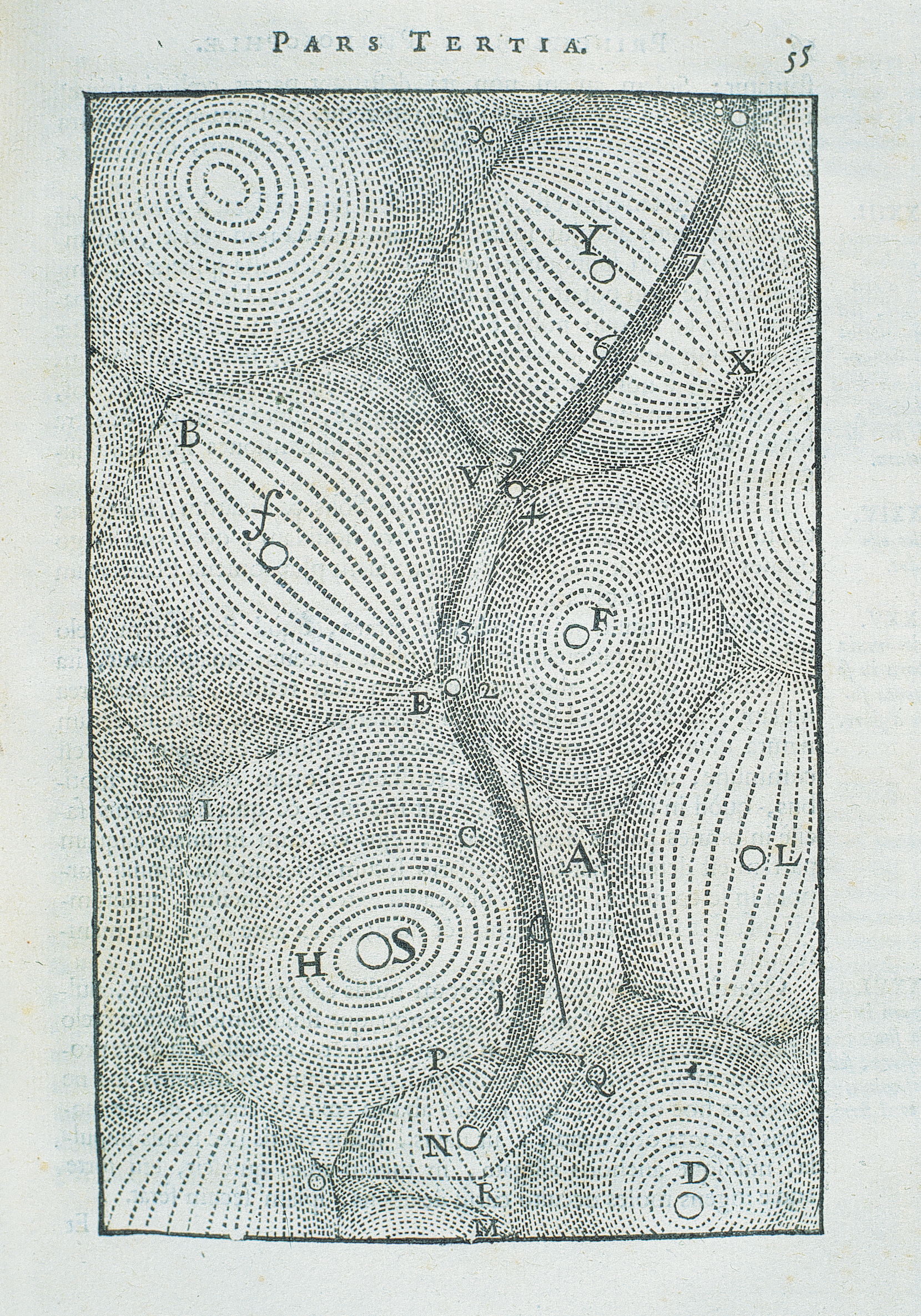
If the abandonment of the traditional image of the cosmos is evident in the writings of Galileo and Descartes, their stance on the issue of the plurality of inhabited worlds is much more cautious. First, a premise: in some paragraphs of the Principia, Descartes deduces from his definition of extension the impossibility of multiple worlds: if the void is contradictory, then all existing matter must be conceived as a continuum and therefore as part of a single world. What Descartes rejects is the ancient and medieval theory of the plurality of worlds – that is, the possibility that various systems exist or are created, separated by a void. On the contrary, he is, as we have seen, favorable to the existence of several worlds understood as a plurality of planetary systems similar to our own, contiguous with one another. The expression “plurality of worlds” is ambiguous: thus Descartes was accused by supporters of the philosophia recepta (and not only by them, as shown, for example, by the objections raised by Henry More and Antoine Arnauld) of infringing divine omnipotence and violating the decree of 1277 – since he argues for the necessary uniqueness of the world – although his philosophy provided the foundation for Bernard Le Bovier de Fontenelle’s Entretiens sur la pluralité des mondes. Unlike Fontenelle, and in harmony with Galileo, Descartes is very prudent when it comes to pronouncing on the existence of inhabitants on other planets.
The Pisan scientist, in the Third Letter on Sunspots (1613), had on the one hand excluded the possibility that other planets might harbor beings entirely similar to those on Earth, and on the other refrained from taking a position on whether there might be forms of life so different from ours as to be almost unimaginable to us. Statements of this sort also appear in the Dialogue Concerning the Two Chief World Systems with reference to the Moon: its physical structure, which Galileo believed to lack rainfall (and in a letter he would later also deny the presence of water on the Moon, contrary to what he had asserted in the Sidereus Nuncius), precludes thinking it could host life forms comparable to those on Earth. Yet two principles argue in favor of the presence of living beings: first, the Moon would be a useless and superfluous body if it were uninhabited; and second, Nature’s richness and divine omnipotence far exceed the limits our weak cognitive faculties would impose on them.
If we turn to Descartes’ writings, in a letter to Hector-Pierre Chanut, ambassador to Sweden, he replies to Queen Christina in terms similar to Galileo’s. The immense dimensions of the universe described in the Principia do not seem to him a cause for concern, not only because other authoritative figures, such as Nicholas of Cusa, held similar views, but also because the vastness of Creation urges us to praise God with greater fervor and admiration. As for the existence of extraterrestrials, the biblical narrative bears witness to God’s special care for us, but it does not exclude that He may have shown equal solicitude toward other creatures. Nevertheless, Descartes prefers not to take a stance on this hypothesis, as the reasons for and against appear to him to be evenly balanced.
When we also consider authors and texts of lesser prominence than those examined so far, we see the same phenomenon clearly taking shape: the infinite universe of the atomists and of Bruno is not accepted; instead, the uniformity of the cosmological model proposed by the Italian philosopher is adopted in order to develop a theory of the plurality of worlds, grounded in the analogies between Earth and the planets, and between the Sun and the stars. There are, however, some exceptions: authors such as John Wilkins and Pierre Borel seem rather to share the type of universe described by Kepler, since they retain the sphere of the fixed stars and do not accept making the stars the centers of planetary revolutions. Both Wilkins’ The Discovery of a World in the Moone (1638) and Borel’s Discours nouveau prouvant la pluralité des mondes habités (1657) are extremely rich in references to the earlier literature on this theme but, perhaps for this very reason, their line of argument is not always entirely consistent. Particularly significant is the presence of Campanella’s work: he had, in fact, the merit of formulating the argument that makes it possible to believe in the existence of extraterrestrials without coming into conflict with the biblical account of Redemption. The inhabitants of other planets, according to this reasoning, would not be human beings and therefore we need not concern ourselves with questions about their salvation. What these two authors seem most concerned with is, above all, to provide arguments in favor of the Copernican system (Borel, although he expresses support for the infinity of the universe in some sections of his work, later speaks of the Sun as the center of the world) and to develop the analogy between the Earth and the opaque bodies of our solar system, particularly the Moon. As would become increasingly common over the following decades, the immense dimensions of the universe and the presence of life on other planets were employed as tools of apologetics.
In a diametrically opposite sense, Savinien de Cyrano de Bergerac, in his L’autre monde ou les empires et états de la lune (1657), takes a stand in favor of an infinite universe. We do not know whether he had read Bruno’s dialogues, but it is certain that in his works infinitism once again reveals all its heterodox potential. Cyrano’s universe is not only infinite but also eternal; and as if this were not enough, humankind has lost all preeminence within it. This is the aspect that most interests the author: that the world is devoid of hierarchies and privileged places reflects the idea that all forms of life constitute a continuum and that there is no longer any difference between humans and animals. Cyrano uses every tool at his disposal to achieve this goal: he sets forth philosophical theories – not always coherent, yet nonetheless converging on the same naturalistic outcome – and, above all, employs the device of inverted representation. He often attributes to the inhabitants of the Moon and the Sun customs and opinions similar to our own: the defamiliarizing effect of seeing anthropocentric arguments enacted by non-human beings, and even deployed in actual trials against the protagonist, serves to expose their vanity. In other cases, Cyrano resorts to the technique of paradoxical praise: as with the cabbage, which in the end proves to stand higher than man in the hierarchy of beings. From Copernicus, then, we move on to infinite and eternal matter, which needs no providential God to organize it; while anti-anthropocentrism becomes an opportunity to ridicule the idées reçues, to emphasize the unity of living beings, and to cast doubt upon the dogma of the soul’s immortality – thus bringing to an end any claim of human superiority over animals.
With the exception of these cases, the vast literature on the plurality of worlds rejects the notion of an infinite universe, yet conceives the stars as the centers of other planetary systems. At times, elements taken from Bruno’s writings are explicitly reused to support the analogy between stars and the Sun – though removed from the necessitarian context in which they originally arose. This is the case with Pierre Gassendi, who in the Syntagma philosophicum (1658) devotes a chapter to the question of whether the world is unique and rejects the theory of an infinite universe – mentioning Bruno explicitly in a marginal note – yet elsewhere in the same work repeats arguments drawn from Bruno to show that the stars are scattered through the heavens like trees in a forest, and that the world is uniform. More often, however, as in the works of Wilkins and Borel, the argument draws upon other philosophical traditions far removed from Bruno’s heterodoxy. Demonstrations of the plurality of inhabited worlds employ arguments that recur, with only minor variations, from one text to another. First and foremost, the vastness of the universe becomes an instrument for glorifying divine omnipotence. This is the case in Gassendi’s Syntagma philosophicum, but also in the Defensio Cartesiana (1652) by Johannes Clauberg, a German philosopher who distinguished himself by defending Descartes against the attacks of the supporters of the philosophia recepta, who sought to prevent his theories from being taught in the universities. By the end of the century this argument would become a veritable leitmotiv in the writings of the English Newtonians. Another proof frequently adduced in favor of extraterrestrial life also has an apologetic value: if the Earth alone were inhabited, the countless other planets scattered through the depths of space would be sterile and useless. This argument is employed not only by Galileo and Borel, but also by Fontenelle, Huygens, and Bentley. Though clearly reminiscent of the Aristotelian maxim that Nature does nothing in vain – a maxim that does not necessarily entail a reference to divine omnipotence and wisdom – it can nonetheless serve as the point of departure for praising the Creator. Less often, and typically in writings of a more scientific character – though sometimes aimed at a wide readership – the existence of extraterrestrials is inferred from analogies between Earth and the other planets: this is the approach adopted by Fontenelle and Huygens. The use of teleological reasoning does not, finally, exclude the presence of a persistent anti-anthropocentric polemic: as Gassendi, Borel, and Huygens assert, precisely because the universe is not entirely ordered for man’s sake, and because we ought not imagine that everything is made in our image and likeness, it is plausible that the other planets are inhabited. Even bodies whose physical structure is less similar to that of the Earth may harbor living beings – perhaps utterly unlike those that populate our globe.
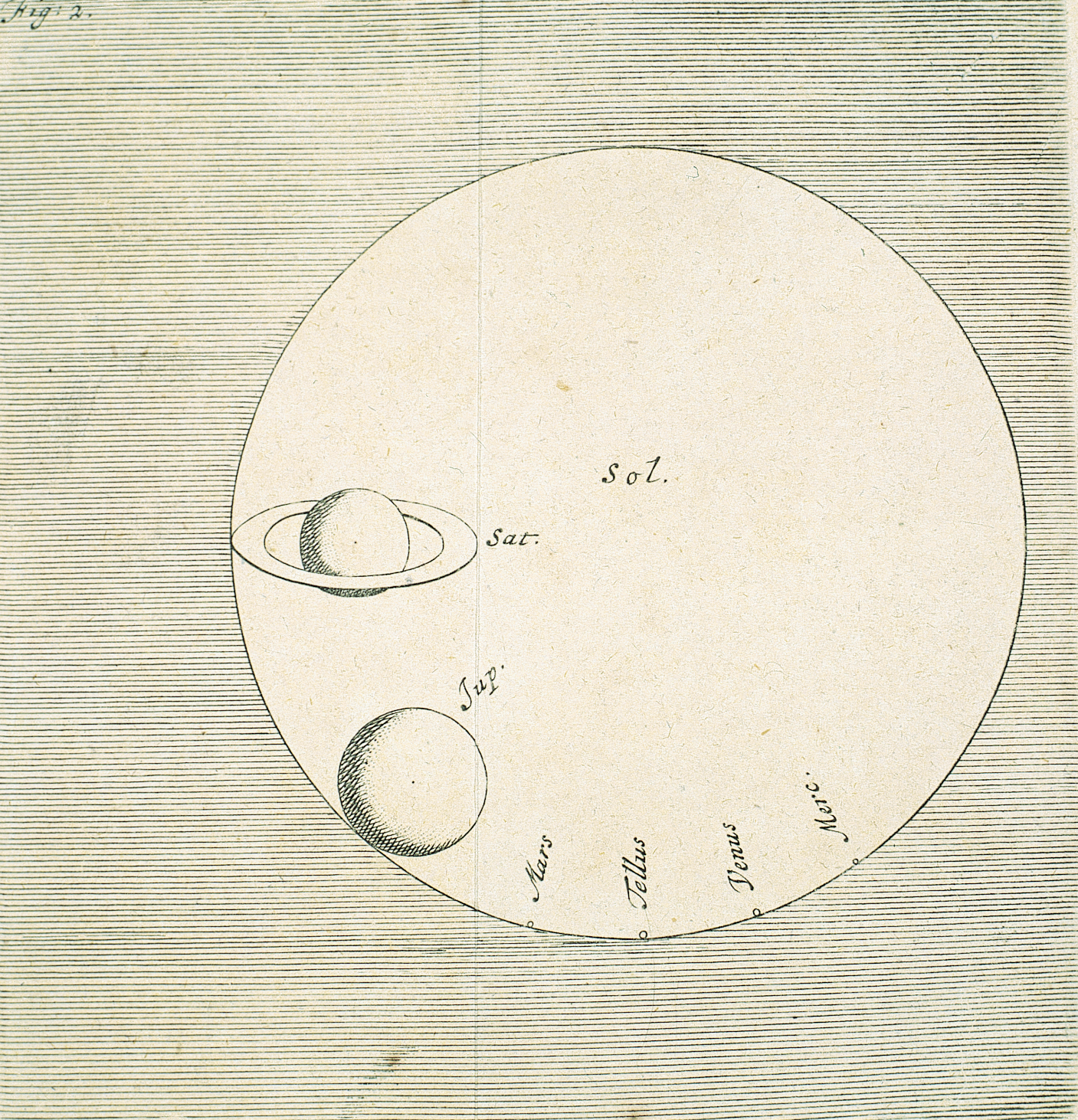
On the nature of extraterrestrials opinions diverge. The majority of authors incline toward the solution already proposed by Campanella: that they differ as much as possible from human beings; this is the simplest way to avoid embarrassing questions regarding their origin and salvation (it is no coincidence that a Dutch theologian, Samuel Desmarets, deplored the theory of inhabited worlds for encouraging the spread of doctrines as dangerous as those advanced by Isaac de La Peyrère concerning the preadamites). There are, however, some exceptions. Chief among these is Christiaan Huygens: officially, in the Kosmotheoros, he states that extraterrestrials are not true human beings. Yet when he describes them, the matter takes a different turn: they must possess our five senses, since each of them is indispensable and constitutes a necessary condition for the fundamental activities of humankind; they must have hands and feet; it is likely that they are subject to vices, for without these the arts would never have arisen among us – all born of the need to overcome the obstacles imposed by Nature or by our own limitations. Above all, they must have developed sciences (especially astronomy) and moral principles akin to our own. As for the latter, reason dictates how to preserve life and maintain civil society: it is inconceivable that, despite differences in customs, there should not also be agreement on Jupiter or Mars concerning the principles of justice and injustice. A fortiori, the laws governing the pursuit of truth, logical consistency, and mathematical principles must likewise be universally diffused among them.
This is neither a lack of imagination on Huygens’ part nor narrow anthropomorphism: in his description of extraterrestrials, the same principle operates that guided his demonstration of the habitability of worlds – namely, the necessity of not making Earth a privileged and unique place. Here emerges the reason why the Dutch scientist’s argumentation follows a curious path, proceeding from the more complex to the simpler: since our planet must be equal to all others, the first aspects upon which his conjectures dwell are not the simplest (such as water, an element indispensable for life), but the most complex, without which such equality would be incomplete. If the chain of analogies were to break at a certain link, differences could arise that might take on axiological significance. This compels him to start from the top and work downward: there must be animals on other planets, which implies that there are also plants and water; only the presence of this last element is debated on observational grounds. A fundamental characteristic of the theory of the plurality of worlds is the application of the principle of the uniformity of the Universe, from which derive the use of analogy and the rejection of anthropocentrism; it follows that on the various planets there cannot manifest an infinite variety of creatures so great as to prevent the recognition of recurring fixed structures and laws, not only at the physical level but also at the biological level. In other words, there must exist on other worlds some forms of life, and they must be at least comparable to our own. This amounts to asserting that, even in the unfolding of His infinite power, God follows rules.
The second exception is represented by a text composed at the end of the seventeenth century, probably by Jean Terrasson: the Traité de l’infini créé, circulated clandestinely as a manuscript and then printed in 1769 under the false attribution to Malebranche. The author of this work radicalizes the doctrines of the Oratorian, thereby confirming the accusations of determinism launched by his opponents: it is not intelligible extension that is infinite, but matter itself, because such is the nature of the idea of extension that we possess and because an infinite cause must have an infinite effect. Not only that: matter is also eternal and necessary. As for the inhabitants of other planets, the Traité openly polemicizes with Fontenelle: one should not appeal to the infinite richness and diversity of Nature’s works without first defining the role of the law of uniformity and the law of variety. The first law acts on everything essential, and in this domain lie the characteristics of the various animal species; the second is limited to producing variations in particulars, but only starting from the structures that the law of uniformity has produced: this is the case, for example, with the different peoples scattered across the Earth. According to the author of the Traité de l’infini créé, then, the differences between us and the inhabitants of other planets could consist in the shape and details of the face or in the number of senses they possess, but extraterrestrials will undoubtedly have a face and senses. If this is the solution adopted concerning the nature of extraterrestrials, an immediately thorny problem arises: the need to avoid contradicting the dogmas of the Incarnation and Redemption. The solution proposed in the treatise in question is rather bold: the Incarnation of the Word takes place on all planets, even on those where men have not fallen into sin. An appeal is immediately made to an indisputable auctoritas: in the Summa theologiae of Thomas Aquinas, we read that the Word could have been united hypostatically to more than one man. Our manuscript, however, overlooks the existence of a paragraph devoted to refuting those who maintain that the Second Person of the Trinity would have become incarnate even if man had not sinned; for Thomas, one must adhere to the letter of Scripture, where it is stated that the Word became flesh for our salvation. We may suppose that the author of the Traité, in constructing his theory, drew inspiration from the pages of Malebranche in which he affirms that the Word would have become incarnate in any case, because the union between creature and divinity was necessary to explain God’s decision to create a world, even if imperfect. It should be emphasized, however, that in our text there is no trace of the last part of the original argument, and for good reason: the Universe, being infinite, is in itself a work worthy of God.
Although the existence of extraterrestrials is potentially in conflict with religious orthodoxy and, as we have just seen, requires some effort to reconcile with the dogmas of the Incarnation and Redemption, authors who support the theory of the plurality of worlds generally manage to avoid open conflict with what their Churches have established, applying to these doctrines what Copernicans generally claim in order to reconcile heliocentrism with the Holy Scriptures. For all of them, in fact, the Bible was written to show us the way to salvation; to achieve this goal, the authors of the sacred texts expressed themselves by adapting what they had to say to the understanding capacities of the people. It is precisely so as not to trouble the faithful with astronomical knowledge useless for attaining eternal life that the Scriptures seem to share a geocentric image of the world, and for the same reason make no mention of the inhabitants of other planets. If this is the starting point, then, it is understandable that the theory of the plurality of worlds could take on an apologetic function once its initial ties with atomistic and Brunian doctrines had been forgotten, in countries where the condemnation of the Copernican system promulgated by the Roman Inquisition had no force. This is what happens, between the end of the seventeenth and the beginning of the eighteenth century, in England, among followers of Newtonian theories. There is a widespread conviction that other stars are at the center of planetary systems similar to ours. In reality, Newton does not express an opinion on this theme, since, according to him, to know whether other solar systems exist we would have to know God’s actions, and this is impossible for us. A reference to the possibility of multiple worlds is found only in the Latin edition of the Opticks (1706), but the reader discovers that this is a return to the ancient and medieval theory of the plurality of worlds, because it refers not so much to other solar systems as to God’s power to create universes in which different laws of Nature apply. Newton’s followers, however, enthusiastically adopt the theory of the plurality of worlds, first among them Richard Bentley, who in The folly and unreasonableness of atheism (1693) deduces that the similarities between the stars and the Sun authorize us to believe that they too are surrounded by planets, since the existence of such systems can only be functional to the presence of creatures inhabiting them. Bentley, however, departs from Newton on another point: he believes that the existence of infinite matter in infinite space is contradictory and physically impossible, because either the particles of matter would have been incapable of aggregating, remaining scattered in space without giving rise to the Universe we know, or they would all have converged into a single mass. In the exchange of letters that took place before the publication of Bentley’s sermons, Newton clearly contradicted these conclusions: if matter had been distributed in infinite space, it would have aggregated into various masses, without necessarily converging entirely into one place.
John Ray, too, in The wisdom of God manifested in the works of the creation (1691), manages to use the immensity of the Universe, the existence of an enormous number of solar systems, and the presence in them of inhabited planets as elements to glorify divine wisdom and omnipotence. The same type of arguments would return at the beginning of the eighteenth century in the writings of Nehemiah Grew, William Whiston, and William Derham. The rise of this apologetic use of the theory of the plurality of worlds marks a decisive turning point for natural theology in England. The entire previous generation had deduced from the praise of the wisdom displayed by God in Creation that the Universe was designed for man, whereas Newtonians share with Kepler and Gassendi the opinion that precisely the fact that we cannot believe that distant stars, perhaps only recently discovered thanks to the telescope, were created for our use and benefit authorizes us to think instead that they exist for other beings, different from us.
With its use in an apologetic key, the seventeenth-century trajectory of the theme of the plurality of worlds comes to a close; the eighteenth century will, in some cases, rediscover the heterodox scope of the theory of the infinity of the Universe, but cosmological discussions will take other paths.
Antonella Del Prete
References
- Barker 1993: Barker, Peter, The optical theory of comets from Apian to Kepler, “Physis”, 30, 1993, pp. 1–25.
- Canone 1992: Giordano Bruno. Gli anni napoletani e la ‘peregrinatio’ europea. Immagini, testi, documenti, a cura di Eugenio Canone, Cassino, Università degli Studi di Cassino, 1992.
- Cohn 1994: Cohn, Jonas, Histoire de l’infini. Le problème de l’infini dans la pensée occidentale jusqu’à Kant, trad. et présentation par Jean Seidengart, Paris, Éditions du Cerf, 1994 (ed. orig.: Geschichte des Unendlichkeitsproblems im abendländischen Denken bis Kant, Leipzig, Engelmann, 1896).
- Del Prete 1998: Del Prete, Antonella, Universo infinito e pluralità dei mondi. Teorie cosmologiche in età moderna, Napoli, La Città del Sole, 1998.
- Dick 1982: Dick, Steven J., Plurality of worlds. The origins of the extraterrestrial life debate from Democritus to Kant, Cambridge-New York, Cambridge University Press, 1982.
- Donahue 1981: Donahue, William H., The dissolution of the celestial spheres, New York, Arno, 1981.
- Duhem 1954–59: Duhem, Pierre, Le système du monde. Histoire des doctrines cosmologiques de Platon à Copernic, Paris, Hermann, 1954–1959, 10 voll.
- Firpo 1993: Firpo, Luigi, Il processo di Giordano Bruno, a cura di Diego Quaglioni, Roma, Salerno, 1993.
- Flammarion 1882: Flammarion, Camille, La pluralité des mondes habités, Paris, Didier, 1882 (1a ed.: 1862).
- Funkenstein 1996: Funkenstein, Amos, Teologia e immaginazione scientifica dal Medioevo al Seicento, Torino, Einaudi, 1996 (ed. orig.: Theology and the scientific imagination from the Middle Ages to the seventeenth century, Princeton (N.J.), Princeton University Press, 1986).
- Granada 1996: Granada, Miguel Ángel, El debate cosmológico en 1588. Bruno, Brahe, Rothmann, Ursus, Roeslin, Napoli, Bibliopolis, 1996.
- Grant 1981: Grant, Edward, Much ado about nothing. Theories of space and vacuum from the Middle Ages to the scientific revolution, Cambridge-New York, Cambridge University Press, 1981.
- – 1994: Grant, Edward, Planets, stars and orbs. The medieval cosmos, 1200–1687, Cambridge-New York, Cambridge University Press, 1994.
- Guthke 1983: Guthke, Karl S., Der Mythos der Neuzeit. Das Thema der Mehrheit der Welten in der Literatur- und Geistesgeschichte von der kopernikanischen Wende bis zur Science Fiction, Bern, Francke, 1983.
- Hellman 1971: Hellman, Doris C., The comet of 1577. Its place in the history of astronomy, 2a ed., New York, AMS, 1971 (1a ed.: 1944).
- Koyré 1949: Koyré, Alexandre, Le vide et l’espace infini au XVIIème siècle, “Archives d’histoire doctrinale et littéraire du Moyen-Âge”, 24, 1949, pp. 45–91.
- – 1984: Koyré, Alexandre, Dal mondo chiuso all’universo infinito, Milano, Feltrinelli, 1984 (ed. orig.: From the closed world to the infinite universe, Baltimore (Md.), Johns Hopkins University Press, 1957).
- Kretzmann 1982: Infinity and continuity in ancient and medieval thought, edited by Norman Kretzmann, Ithaca (N.Y.), Cornell University Press, 1982.
- Lerner 1996-97: Lerner, Michel-Pierre, Le monde des sphères, Paris, Les Belles Lettres, 1996-1997, 2 voll.; v. I: Genèse et triomphe d’une représentation cosmique, 1996; v. II: La fin du cosmos classique, 1997 (trad. it.: Il mondo delle sfere. Genesi e trionfo di una rappresentazione del cosmo, Firenze, La Nuova Italia, 2000).
- Lovejoy 1936: Lovejoy, Arthur O., The great chain of being. A study of the history of an idea. The William James lectures delivered at Harvard university, 1933, Cambridge (Mass.), Harvard University Press, 1936 (trad. it.: La grande catena dell’essere, Milano, Feltrinelli, 1966).
- Maier 1949: Maier, Anneliese, Studien zur Naturphilosophie der Spätscholastik, Roma, Edizioni di Storia e Letteratura, 1949-1958, 5 voll.; v. I: Die Vorläufer Galileis im 14. Jahrhundert, 1949.
- – 1964: Maier, Anneliese, Ausgehendes Mittelalter. Gesammelte Aufsätze zur Geistesgeschichte des 14. Jahrhunderts, Roma, Edizioni di Storia e Letteratura, 1964-1977, 3 voll.; v. I, 1964.
- McColley 1936: McColley, Grant, The seventeenth-century doctrine of a plurality of worlds, “Annals of science”, 1, 1936, pp. 385-430.
- Monnoyeur 1992: Infini des mathématiciens, infini des philosophes, ouvrage collectif sous la direction de Françoise Monnoyeur, Paris, Belin, 1992.
- – 1995: Infini des philosophes, infini des astronomes, ouvrage collectif sous la direction de Françoise Monnoyeur, Paris, Belin, 1995.
- Nicolson 1935: Nicolson, Marjorie H., A world in the moon. A study of changing attitude toward the moon in the seventeenth and eighteenth centuries, Northampton (Mass.), Departments of Modern Languages of Smith College, 1935.
- – 1948: Nicolson, Marjorie H., Voyages to the moon, New York, Macmillan, 1948.
- Ricci 1990: Ricci, Saverio, La fortuna del pensiero di Giordano Bruno. 1600-1750, Firenze, Le Lettere, 1990.
- Rossi 1989: Rossi, Paolo, La scienza e la filosofia dei moderni. Aspetti della rivoluzione scientifica, Torino, Bollati Boringhieri, 1989.
- Sturlese 1987: Sturlese, Rita, Bibliografia, censimento e storia delle antiche stampe di Giordano Bruno, Firenze, Olschki, 1987.
- Tessicini 2001: Tessicini, Dario, ‘Pianeti consorti’: la terra e la luna nel diagramma eliocentrico di Giordano Bruno, in: Cosmología, teología y religión en la obra y en el proceso de Giordano Bruno, al cuidado de Miguel Á. Granada, Barcelona, Publicacions Universitat de Barcelona, 2001, pp. 159-188.
- Westman 1975: Westman, Robert S., The Melanchton circle, Rheticus, and the Wittenberg interpretation of the Copernican theory, “Isis”, 66, 1975, pp. 165-193.
- – 1977: Westman, Robert S., Magical reform and astronomical reform: the Yates thesis reconsidered, in: Hermeticism and the scientific revolution, edited by Robert S. Westman and J.E. McGuire, Los Angeles, University of California Press, 1977, pp. 3-91.